A letter from Olly Richards · est. 2004
Finally learn a language that actually sticks .
7 days free. Cancel anytime.
You don't speak the language yet.
That's the whole point.
Every Uncovered course starts the same way: with a story you don't yet understand — and six layers of scaffolding that quietly get you through it. Here's what those six layers are.
-
You see and hear it together.
A native speaker reads the story aloud. The text is on screen at the same time. You're not deciphering a wall of letters alone — sound and meaning land at the same moment.
(read at your own pace. pause. rewind. nobody's watching.) -
You already know thousands of words.
Cognates do most of the heavy lifting from day one. Científica is scientist. Laboratorio, laboratory. Investigar, investigate. Misterio, mystery. We don't claim this — we show you, on the next paragraph down.
(this is the bit nobody tells you.) -
You're walked through real sentences.
Olly's video lessons break the story apart, sentence by sentence. No grammar tables. No abstract rules. The grammar emerges naturally, from inside a story you already half-understand.
(no conjugation tables. promise.) -
You're taught how to pronounce it.
A native accent expert shows you mouth positioning, rhythm, intonation. So you don't just understand the words — you can say them. Not parrot-style. Properly.
(not 'repeat after me'. ever.) -
You get the cultural context.
Where the story is set. Why the characters do what they do. What that word at the market actually means. Language without culture is just sound. We give you both.
(the bit that makes it stick.) -
You re-listen. Now it lands.
The same sentences that were opaque on pass one are obvious on pass two. That moment — "wait, I can actually do this" — is the one we built the whole method around.
(the moment people email me about.)
Don't believe a beginner could read this? Here's a Spanish sentence you've technically never seen. Read it once, before you scroll on.
La científica visita el laboratorio para investigar el misterio . - científica scientist
- laboratorio laboratory
- investigar investigate
- misterio mystery
That sentence is 80% English already. You're not starting from zero. You never were.
You don't understand everything.
But you understand more than you expected.
The reason it never stuck wasn't you.
It was the
Parrot Method.
"Repeat after me!" — the four most damaging words in language learning. Apps say them. Classes say them. Phrasebooks say them. And then they wonder why a 72-year-old who has lived in Spain for 8 years still can't order coffee.
- Repeat after me.
- Drill the phrase. Drill it again.
- Tap the right box. Earn the streak.
- Forget it by Tuesday.
- Try again next year.
- Read a story.
- Listen to it. Then read it again.
- Care what happens next.
- The words stay because you cared.
- Use them this weekend.
(I named it because I had to. Some villains don't introduce themselves.)
Thirteen languages.
One trial.
The Uncovered series spans thirteen languages today, with more added each year. Pick the one you actually need to speak — at the in-laws', at the market, at the kitchen table — and start the trial there.
- español Spanish the one I learned at 3am
- français French for the in-laws in Lyon
- italiano Italian for the holiday house
- Deutsch German harder than they tell you
- português Portuguese Lisbon or Rio, you pick
- 日本語 Japanese two scripts, one story
- 한국어 Korean the alphabet is a delight
- 中文 Mandarin yes, by reading
- 粵語 Cantonese for the grandparents
- русский Russian novels, eventually
- العربية Arabic right to left, top to bottom
- Türkçe Turkish vowel harmony does its job
- dansk Danish yes, even Danish
- … and more soon we never stop adding
Every Uncovered course is the same shape: story → audio → walkthrough → pronunciation → culture → re-listen. The language changes. The method doesn't.
Honest answer:
it depends.
It works for a lot of people. It doesn't work for everyone. Before you put your name in, here's the short, unflattering list.
- You're tired of "repeat after me" — you want to actually understand.
- You learn better through reading and listening than drilling flashcards.
- You want to talk to in-laws, neighbours, friends — not pass an exam.
- You can give it 20 minutes a day for a few months.
- You want instant fluency in 30 days. (Nobody can sell you that.)
- You hate reading. The whole method runs on a story.
- You want gamified flashcards and a streak counter.
- You're prepping for a specific exam in two weeks.
Real students.
Real "finally".
These are quotes from people who'd already given up — pulled near-verbatim from our survey responses. No "world-class learners". No teenagers. No before-and-afters. Just people who'd tried everything.
-
I've tried for 18 years. Then I read a story.
We have a home in Spain. I'd tried Duolingo, Babbel, Rosetta Stone, classes in the village. None of it worked. Three stories in, I caught myself thinking in Spanish while I made tea. I cried, actually.
-
Day 620 of Duolingo. I'd learned nothing.
I was furious with myself. My grandkids in Mexico City speak no English. I switched to StoryLearning out of spite. Six weeks in, I had a real conversation with my granddaughter. About a turtle. That was the moment.
-
I'm 76. I'm a slow learner. This worked anyway.
I kept waiting for the part where they make me repeat phrases. It never came. I just kept reading. The words stayed because I wanted to know what happened next. I didn't think I was capable.
On the day I stopped breathing , I got up at 3am to see the mountains.
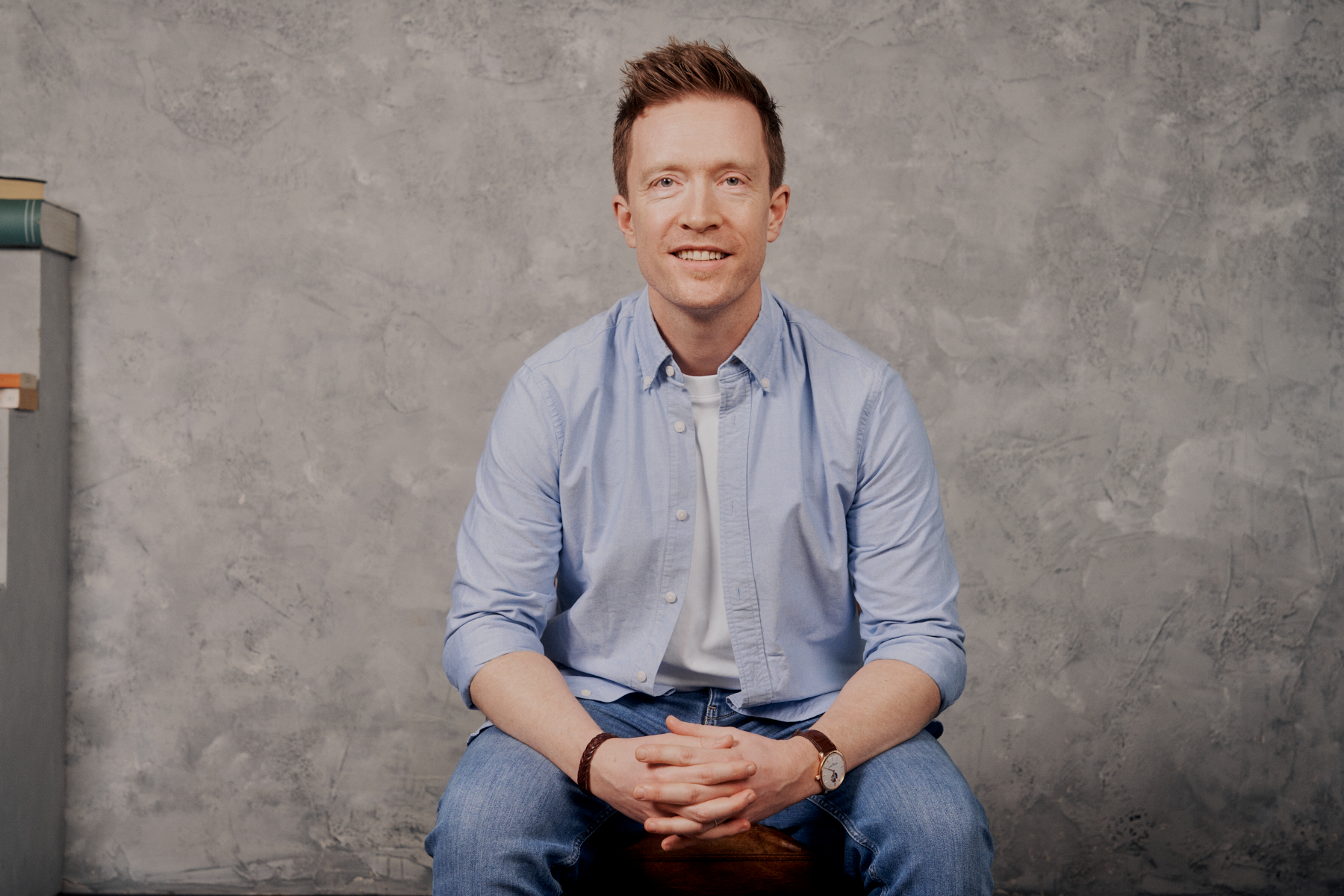
I'm Olly Richards.
I write books that teach languages. Twelve titles with HarperCollins. Translated into a dozen languages, in print in proper bookshops. A podcast you might know — I Will Teach You A Language. A YouTube channel a few hundred thousand of you have shouted at me from.
But the books were never quite enough. People kept asking me to walk them through the story — sentence by sentence, with the audio, with the grammar surfacing as we went. So I built the course. Twelve languages and 250,000 students later, we still call it the Uncovered series.
-
I thought I was dying.
It was 2004. I was high in the mountains, in a small village called Iruya — 2,780m above sea level. I'd had ten days of altitude sickness already.
At 3am, I woke up. Something was wrong. I couldn't breathe.
(this is the moment.) -
I was too scared to sleep.
So I sat in bed with the only thing I had with me — a battered Spanish novel by Gabriel García Márquez. El amor en los tiempos del cólera.
My Spanish was nowhere near good enough to read it. I tried anyway. The story dragged me through pages I couldn't fully understand. By dawn, I'd read more Spanish in one night than I had in three years of classes.
(this was the bit that broke my brain.) -
Then I tested it.
I came down the mountain and rejoined my friends. Argentines, all of them, speaking at full speed.
For the first time in my life, I kept up. I laughed at jokes. I lost my place and found it again. None of it felt like the classroom. It felt like being a person who happened to speak Spanish.
I've been refining what happened that night for twenty years. Across twelve languages. With a few hundred thousand students. The method has a name now. The villain has a name too.
(the villain has a name. you've met him.)
- 12 books with HarperCollins
- 20yrs refining this method
- ¼M students & counting
One last thing
Try the course.
For a week, on me.
Open up the full Uncovered course in any of thirteen languages. Read the story. Listen to it. Watch a few of the walkthrough lessons. See if the words actually stick this time. If they do, the rest is waiting for you. If they don't, you've lost a quiet week with a good story.
7 days free. Cancel anytime.
If you decide to keep the course
- $297 one-time payment
- Lifetime access, no subscription
- 365-day money-back guarantee